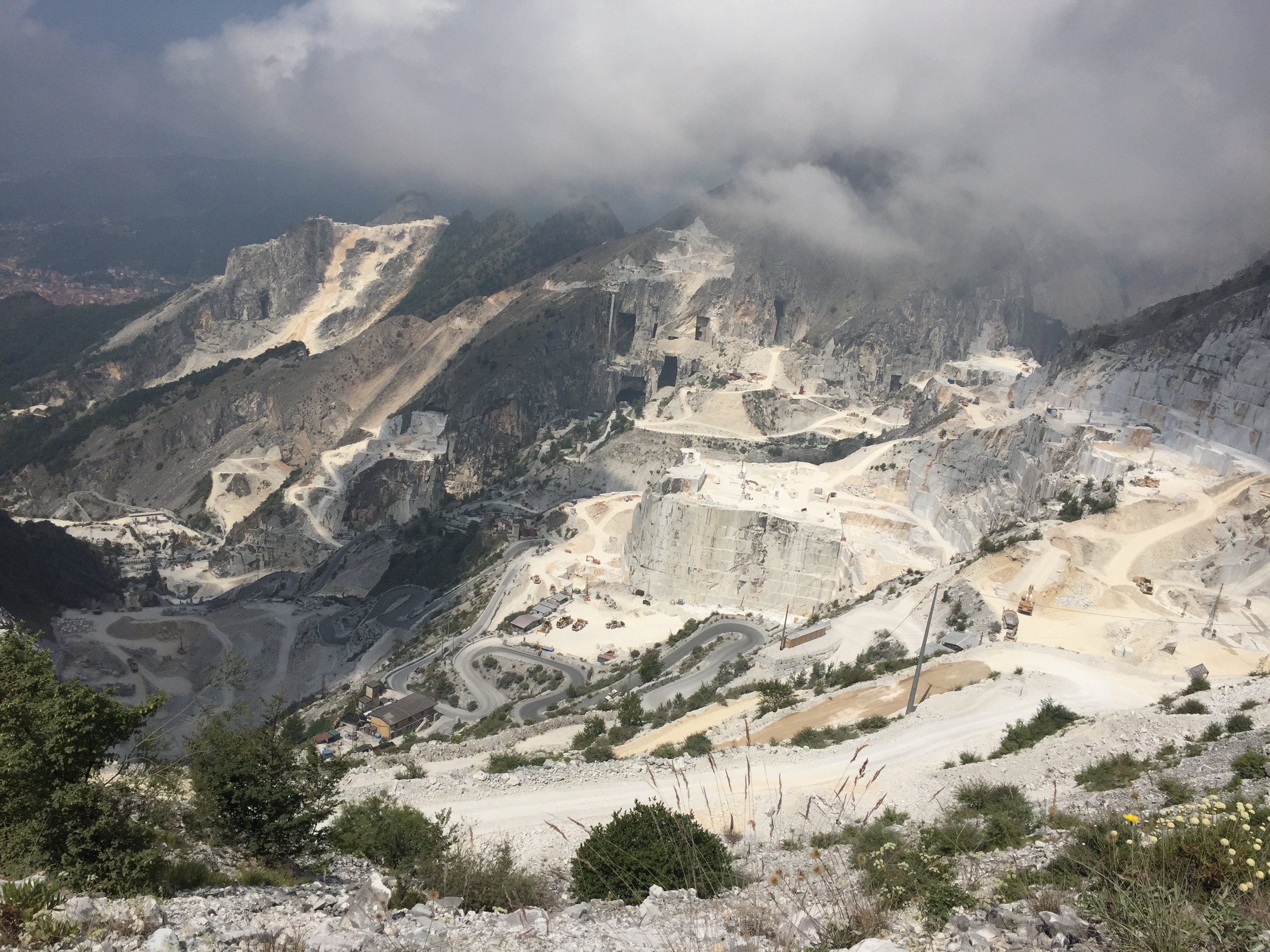
The Apuan Alps form a narrow coastal range in northern Tuscany, rising to just over 1,900 metres above the Ligurian Sea. Their geological peculiarity — a metamorphic sequence in which limestone has been converted to calcite marble by heat and pressure — has made them the most intensively quarried mountain range in Europe. The extraction record spans more than two thousand years, with no significant interruption, from Roman municipal contracts to present-day export operations.
Understanding this history in sequence matters for anyone engaging with the Carrara district today, because the institutional, ownership, and technical structures of the current industry were shaped by decisions made across each historical period. The municipal ownership of quarry concessions, the persistence of family-held operations, and the particular geography of the three main basins all derive from historical precedents that remain legally and practically active.
Roman Extraction at Luna
The earliest documented Roman extraction at what is now the Carrara district dates to approximately 48 BCE, when Caesar Augustus's engineers began systematic quarrying from the coastal approach through the settlement of Luna — the Roman city whose ruins lie at modern Luni, some fifteen kilometres from Carrara. The stone was transported by river barge down the Carrione and Frigido rivers to coastal loading points, then by sea to Ostia and Rome.
Roman quarrying at the Apuan Alps operated on a scale that did not distinguish between the premium grades later identified as Statuario or Calacatta and the broader white-grey mass used for construction. The Pantheon, completed in its current form under Hadrian around 125 CE, used Lunense marble — the Roman name for Carrara stone — for floor paving; Trajan's Column, completed in 113 CE, was carved from a single continuous grade of white Lunense. The supply relationship between the Apuan quarries and Roman construction continued through the second and third centuries CE, with output volume difficult to establish precisely but estimated at tens of thousands of tonnes per decade at peak periods.
Roman extraction technique relied on iron wedge splitting along natural fissure lines, fire-setting to fracture larger masses, and human and animal traction on wooden sledges to move blocks to the river transport points. The terraced bench cuts still visible in the Fantiscritti basin's upper walls are now accepted by archaeologists as Roman in origin, predating the medieval and Renaissance extraction that later used the same approach angles.
Medieval Interruption and the Episcopal Concessions
Following the dissolution of Roman administrative infrastructure in the fifth and sixth centuries CE, organised large-scale extraction from the Apuan Alps ceased. The quarry areas reverted to nominal control under the bishops of Luni, whose territory encompassed both the coastal plain and the mountain approaches. Medieval extraction was sporadic and local — building stone for fortifications and churches in the immediate area — rather than the systematic commercial operation of the Roman period.
The key institutional development of the medieval period was the establishment of episcopal concession rights over quarry access. The bishops of Luni-Sarzana held formal authority over extraction permits through most of the medieval period, a precedent that translated, after the absorption of Carrara into the Este domain in 1473, into municipal concession control — the system that still governs quarry rights today, under the authority of the Comune di Carrara.
Renaissance Demand and the Carrara Transformation
The decisive transformation of the Carrara quarry district into a specifically named and commercially significant source occurred during the fifteenth century. Michelangelo's documented visits to Carrara — the first in 1497 to select marble for the Pietà, later visits for the Julius II tomb project and the Medici Chapel commissions — established Carrara stone as the sculptural medium of the Italian Renaissance and created an international market that has never entirely dissipated.
Michelangelo's approach to the quarries was highly specific. His surviving letters describe extended periods in the Fantiscritti and Ravaccione basins, selecting individual blocks with particular attention to the absence of taroli — the crystalline irregularities in the marble mass that cause unexpected fracture during carving. The distinction Michelangelo drew between Statuario quality — white, fine-grained, essentially tarolo-free — and the broader mass of Carrara white marble was not invented by him, but his documented practice codified it for the market and for subsequent generations of quarry operators.
By the sixteenth century, the Este duchy had organised quarry concessions on a systematic basis, with families holding multi-generation rights to specific extraction fronts. The Henraux family — whose company remains one of the largest quarry operators in the district today — traces its involvement in Carrara stone to the early nineteenth century, but the family ownership model they represent was established under Este governance two centuries earlier.

Industrial Extraction: The Nineteenth and Early Twentieth Centuries
The introduction of steel wire saws in the 1890s fundamentally altered the economics and scale of Carrara extraction. Before wire-saw technology, marble blocks were separated from the quarry face by a combination of wedge splitting, channelling with hand chisels, and explosive charges. The wire saw — a continuous loop of steel wire fed with abrasive slurry, running at speed across the marble face — enabled clean, predictable cuts of dimensions previously impossible, and dramatically reduced the proportion of stone lost to breakage in the separation process.
The late nineteenth century also saw the construction of the Ferrovia Marmifera di Carrara — the marble railway — connecting the quarry basins to the port of Marina di Carrara. Completed in sections between 1876 and 1891, the narrow-gauge line replaced the earlier lizzatura system of sledge transport on stone ramps, which had required teams of up to a dozen workers and oxen to move each block. The railway increased transport capacity and reduced unit shipping costs sufficiently to make Carrara marble economically competitive in markets as distant as the United States and Argentina.
By 1900, the Carrara district employed approximately five thousand workers directly in quarry extraction and marble processing, with a further significant number in transport, toolmaking, and associated trades. The social and political character of the Carraran workforce — strongly anarchist and syndicalist, the subject of sustained academic study — was shaped during this period, and its legacy persists in the labour relations culture of the district today.
Post-War Reconstruction and the Expansion of Industrial Grades
The post-war Italian construction boom of the 1950s and 1960s created demand for marble at volumes the artisan and semi-industrial quarries of the interwar period could not supply. The response was the mechanisation and enlargement of extraction fronts across all three major basins, with the introduction of diamond wire saws — more efficient and longer-lasting than steel wire — and motorised block loaders replacing the manual handling that had characterised even the larger pre-war operations.
This period also saw the definitive separation between the premium sculptural grades — Statuario, Calacatta, and Arabescato — and the industrial construction grades, primarily Bianco Carrara C and CD. The premium grades continued to be extracted from specific, limited fronts in the upper Ravaccione and parts of Fantiscritti, while industrial Bianco Carrara was extracted at scale from expanded fronts throughout all three basins. The two markets operated with largely separate supply chains, pricing mechanisms, and customer relationships.
Current Operations and the Contemporary District
As of 2026, approximately three hundred active quarry concessions operate in the Carrara municipality, with a total annual extraction volume in the range of four to five million tonnes. The district exports approximately 1.3 billion euros of marble and marble products annually, the majority going to China, the United States, Germany, and the Gulf states.
The municipal concession system — under which the Comune di Carrara holds ownership of the quarry subsoil and leases extraction rights to private operators — has been the subject of ongoing legal and political dispute for decades. Critics argue that concession fees have historically been set far below market value, effectively subsidising private operators at public expense. A 2019 regional law requiring updated concession valuations remains in partial implementation.