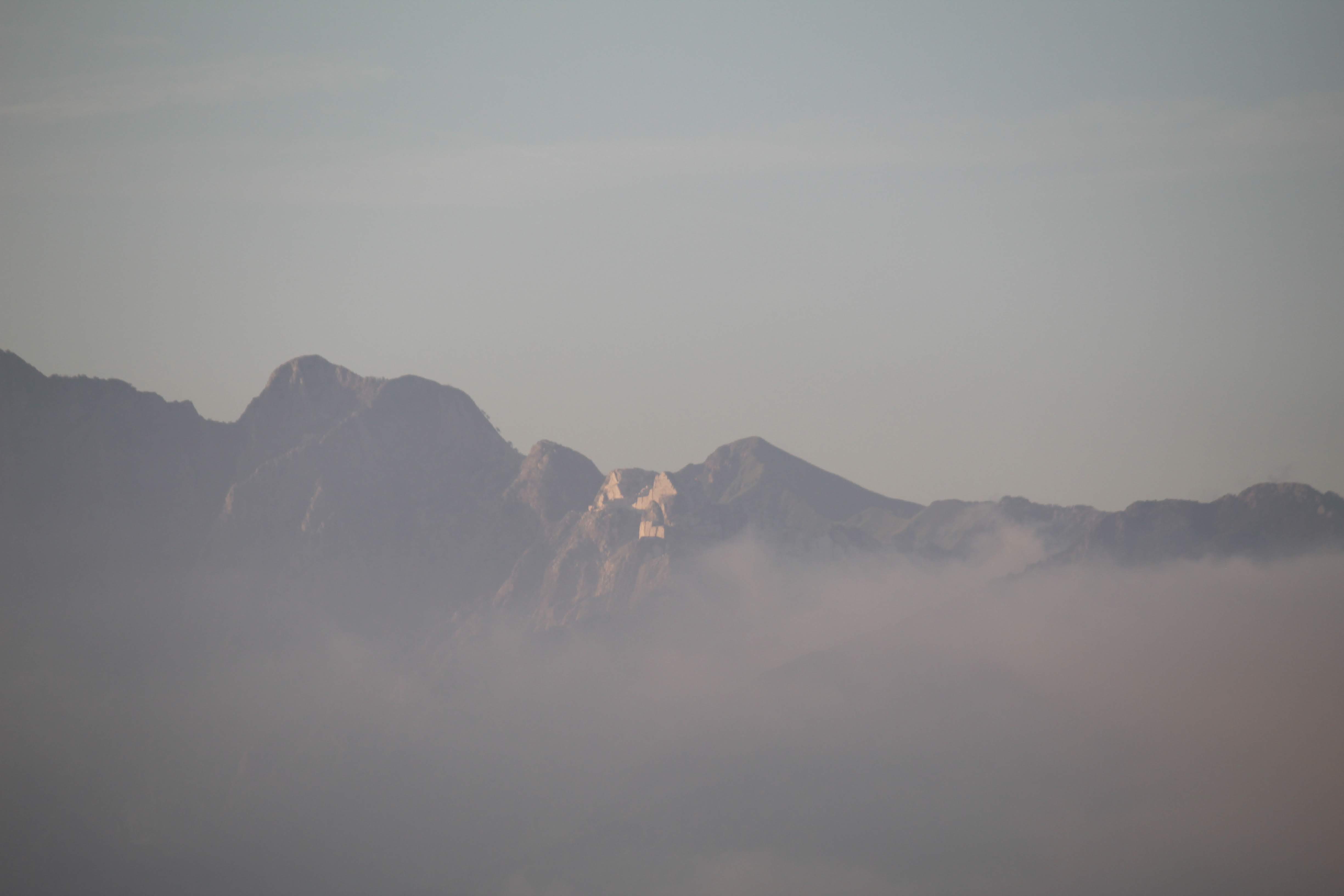
The Carrara quarry district presents one of the more direct conflicts between industrial extraction and landscape heritage in Italy. The Apuan Alps are simultaneously a protected Regional Park, a UNESCO-recognised natural landscape, and the site of active large-scale quarrying. The coexistence is not passive: it generates ongoing legal disputes, regulatory revisions, and public debate that have intensified since the early 2000s as environmental monitoring has improved and quarry expansion proposals have accumulated.
This article describes the principal environmental impacts documented in the district, the legislative framework governing quarry activity, and the heritage protection arguments that have emerged in opposition to unrestricted extraction.
The Marble Slurry Problem
Marble sawing and processing produces marmettola — a fine white calcium carbonate slurry that was, until regulatory intervention in the 1990s, discharged directly into the Carrione river. The visual effect — a white river — became a widely cited image of industrial environmental impact and contributed to the early environmental campaigning against the district's practices.
Current regulations require slurry treatment and either recycling or controlled disposal. Recycling applications have expanded significantly: marmettola is now used in cement production, paper manufacturing, agricultural soil amendment, and as a filler in a range of industrial materials. The volume of marmettola produced annually in the district is estimated at between eight hundred thousand and one million tonnes — comparable to the total volume of finished marble product exported.
Despite regulatory improvements, monitoring data from the Autorità di Bacino del Fiume Arno and the Agenzia Regionale per la Protezione Ambientale della Toscana (ARPAT) have recorded recurrent exceedances of permitted turbidity and calcium carbonate levels in the Carrione and Frigido rivers, attributed to inadequate slurry containment at active quarry sites during periods of heavy rainfall. The Carrione in particular, which flows through the centre of Carrara city before reaching the sea at Marina di Carrara, carries measurable calcium carbonate loading that environmental monitoring stations flag as above background levels in most measurement periods.
Groundwater and Aquifer Impacts
The Apuan Alps serve as a significant groundwater recharge zone for the coastal plain of the Versilia and Lunigiana. Quarry operations alter the hydrogeology of the mountain mass in several ways: excavation lowers the surface elevation of the water table at quarry sites, quarry roads and bench cuts change surface runoff patterns, and the use of water for wire-saw cooling and slurry transport affects local aquifer recharge rates.
Several of the natural springs in the Apuan Alps — some of which feed bottled water operations and others of which supply rural agricultural users — have shown flow reduction in recent decades. Attributing this reduction specifically to quarry activity rather than to longer-term precipitation changes is methodologically contested; however, the correlation between expanded quarry fronts in certain basins and flow reduction in adjacent springs is sufficiently consistent to have been included in the environmental impact assessments submitted with recent quarry expansion applications.
Landscape Change and the Visual Impact Debate
The white scars left on the Apuan Alps by active and exhausted quarry fronts are visible from the Ligurian coast and from considerable distances inland. Photographs comparing the mountain profile in the 1920s to the present show a substantial increase in exposed white marble face area — the consequence of both expansion of individual quarries and the conversion of underground extraction to open-pit methods, which is faster and cheaper but removes the mountain surface rather than tunnelling beneath it.
The aesthetic and heritage arguments against continued quarry expansion take several forms. The most legally significant is the position of the Ente Parco Regionale delle Alpi Apuane — the body administering the Regional Park designation — which includes the quarry zone within its perimeter and has consistently argued for tighter extraction limits, mandatory restoration of exhausted fronts, and prohibition of open-pit conversion where underground methods remain viable.
The Regione Toscana's Piano Paesaggistico Regionale, updated in 2015, includes specific provisions for the Apuan Alps landscape that impose constraints on new quarry authorisations based on visual impact assessments from designated viewpoints. Implementation has been uneven, with a number of authorisations granted that were subsequently challenged before the Regional Administrative Court (TAR Toscana).

The Regional Park: Jurisdiction and Conflict
The Parco Regionale delle Alpi Apuane was established in 1985. Its perimeter includes most of the high mountain areas of the Apuan range, but the quarry basins — particularly the lower, more accessible sections of Fantiscritti, Colonnata, and Ravaccione — were excluded from the strictest protection zones to preserve the existing extraction activities.
The boundary between Park protection zones and areas open to quarrying has been the subject of repeated renegotiation. The Park authority's position — that quarry expansion into currently protected zones should not be authorised — conflicts with the Comune di Carrara's economic interest in maintaining quarry concession revenue and employment. The Regione Toscana, which holds ultimate authority over the Park's management plan, has mediated between these positions through a series of Piano Cave (Quarry Plans) that set extraction limits and require environmental assessments for new operations.
The most recent comprehensive Piano Cave for the Carrara district, approved in 2022 after a multi-year revision process, introduces stricter limits on total annual extraction volume from each basin, mandatory slurry treatment certification, and required submission of end-of-concession restoration plans. Environmental organisations including Legambiente have challenged several provisions as insufficient; the quarry operators' association has challenged others as economically disproportionate. Legal proceedings before the TAR Toscana remain active as of early 2026.
Heritage Arguments: UNESCO and Cultural Significance
Italy submitted the Apuan Alps marble landscape for inclusion on UNESCO's World Heritage tentative list in 2006. The submission emphasised both the geological singularity of the marble deposit and the cultural landscape created by two thousand years of extraction — the quarry terraces, the lizzatura routes, the historic laboratori, and the urban fabric of Carrara shaped by the marble trade. The nomination has not advanced to formal evaluation as of 2026, partly because of the inherent difficulty of arguing heritage protection status for a landscape that remains an active industrial site.
The cultural heritage argument is further complicated by the genuine historical significance of the quarrying activity itself. The Fantiscritti basin's Roman-era extraction marks, the nineteenth-century Ferrovia Marmifera infrastructure, and the urban architecture of Carrara — largely built from marble — represent a cultural heritage that is inseparable from the extraction history. Heritage protection in this context cannot straightforwardly mean cessation of extraction; it requires distinguishing between extraction methods, scales, and locations that preserve the historic character of the landscape and those that overwrite it.
Economic Dependency and the Limits of Regulation
The environmental and heritage arguments for stricter extraction limits encounter a structural constraint: the Carrara district's economy has no comparable alternative industry. Approximately three thousand workers are directly employed in quarrying and processing; the broader supply chain of transport, equipment maintenance, toolmaking, and associated commerce depends on the same activity. Municipal budgets in Carrara and Massa-Carrara province receive substantial revenue from quarry concession fees, though the adequacy of those fees is disputed.
The transition scenarios discussed by regional planners and economic researchers have generally focused on tourism, artisan marble processing, and architectural restoration as partial substitutes, rather than full replacements, for industrial extraction. The Marble Museum at Fantiscritti and the established sculpture studio network in Pietrasanta represent existing anchors for a tourism and craft economy, but current visitor volumes and artisan employment figures are insufficient to absorb a significant reduction in industrial quarry employment.